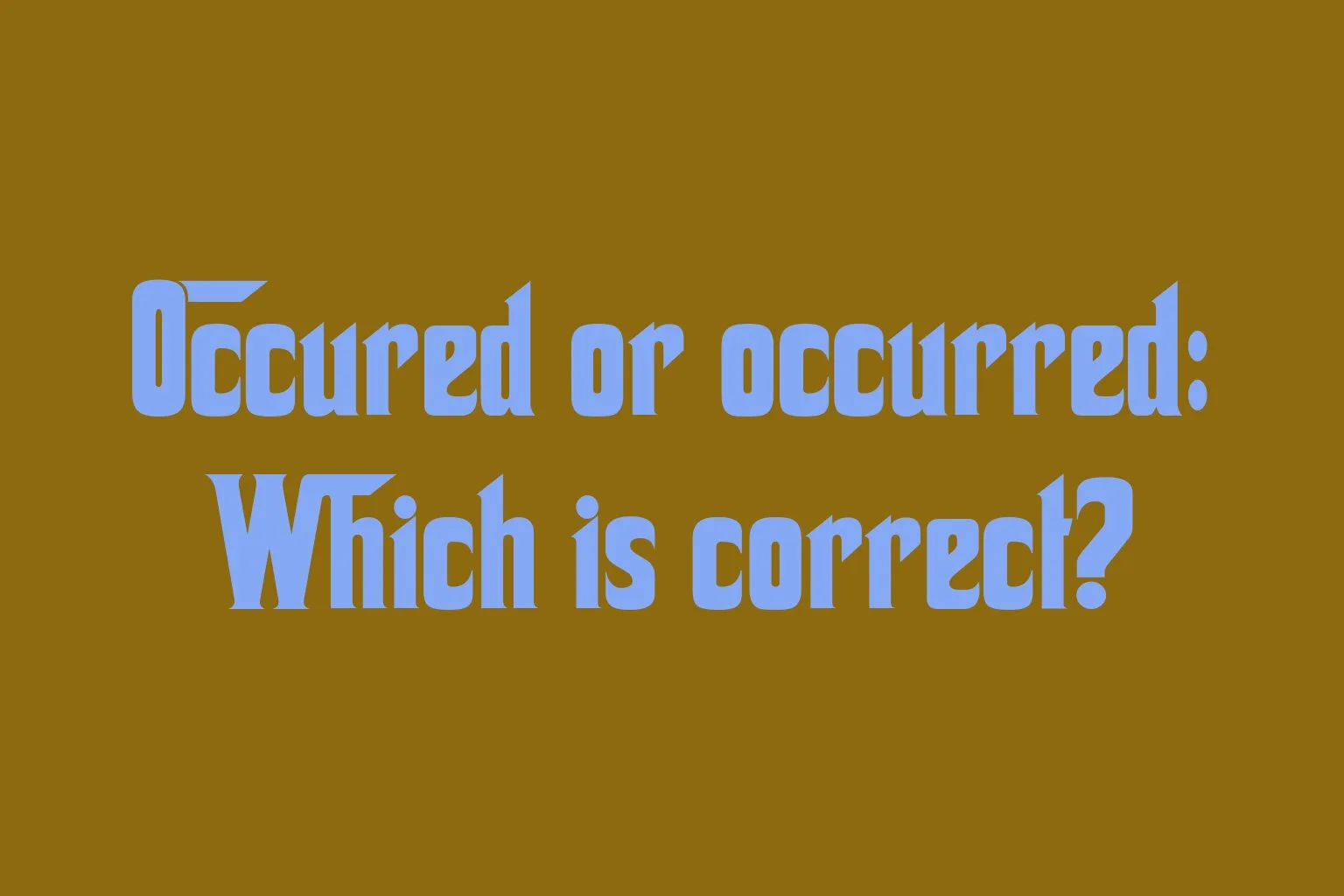
✅ Occurred
Correct. Uses a double ‘r’.
❌ Occured
Incorrect. Missing the second ‘r’.
If you have ever paused while typing to wonder if you need one ‘r’ or two, you are not alone. This is one of the most common spelling questions in the English language. The short answer is simple: Occurred is the only correct spelling. Writing it as occured is a misspelling and should always be corrected. Whether you are writing an email, an academic paper, or a text message, remembering to double the ‘r’ ensures your writing looks professional and polished.
Why Do We Double the ‘R’?
English spelling rules can feel random, but there is actually a logical system behind this specific word. It all comes down to where you place the stress when you speak. The root word is occur. When you say “occur,” notice that the emphasis falls heavily on the second syllable (oc-CUR).
Here is the standard rule for adding suffixes like -ed or -ing:
- If a verb ends in a Consonant-Vowel-Consonant (CVC) pattern.
- And the stress is on the final syllable.
- You must double the final consonant.
Since “occur” ends in C-U-R and the stress is at the end, the ‘r’ gets doubled. This transforms it into occurred (past tense) or occurring (continuous tense). If we didn’t double the letter, the pronunciation might change to sound like “cured,” which would be confusing.
Comparison With Other Words
Seeing other examples helps clarify why this happens. Some words follow the same pattern, while others do not because their stress falls in a different place.
| Base Word | Stress Location | Past Tense (Correct) |
|---|---|---|
| Occur | Last Syllable (oc-CUR) | Occurred (Doubled) |
| Refer | Last Syllable (re-FER) | Referred (Doubled) |
| Offer | First Syllable (OF-fer) | Offered (Not Doubled) |
| Visit | First Syllable (VIS-it) | Visited (Not Doubled) |
As you can see, Offer and Visit do not double the final consonant because the stress is at the start of the word. Occur behaves like “refer” or “prefer,” demanding that extra consonant.
Examples in Sentences
Seeing the word in action is often the best way to memorize it. Here are correct ways to use occurred in everyday sentences. Notice how it fits naturally into both formal and casual contexts.
- “A strange error occurred while I was trying to save the file.”
- “It never occurred to me that the shop might be closed on Sundays.”
- “The incident occurred right before the concert started.”
- “Has this problem occurred in the past, or is this the first time?”
In all these cases, writing occured would be flagged as a mistake by spell-checkers. Visually, the word should look “long” due to the double R sitting in the middle.
Tricks to Remember the Spelling
If you find yourself constantly confused, a simple mnemonic device can save you time. Since the word is about something happening, you can associate the spelling with the “current” of events.
Memory Tip: The word CuRRent has two Rs. An occuRRence is a current event. Therefore, it needs two Rs.
Another way to think about it is simple addition. Occur + Red (like the color). While the pronunciation doesn’t perfectly match “red,” seeing the two ‘r’s together in your mind can help fix the spelling.
Does It Change Across Regions?
Sometimes spelling confusion comes from differences between British and American English, such as with “color” versus “colour.” That is not the case here. Occurred is the standard spelling globally.
- American English: The event occurred at noon.
- British English: The event occurred at noon.
- Australian English: The event occurred at noon.
No matter where your audience is located, sticking to the double consonant form is the safe and correct choice. It is universally accepted in all major English dictionaries.