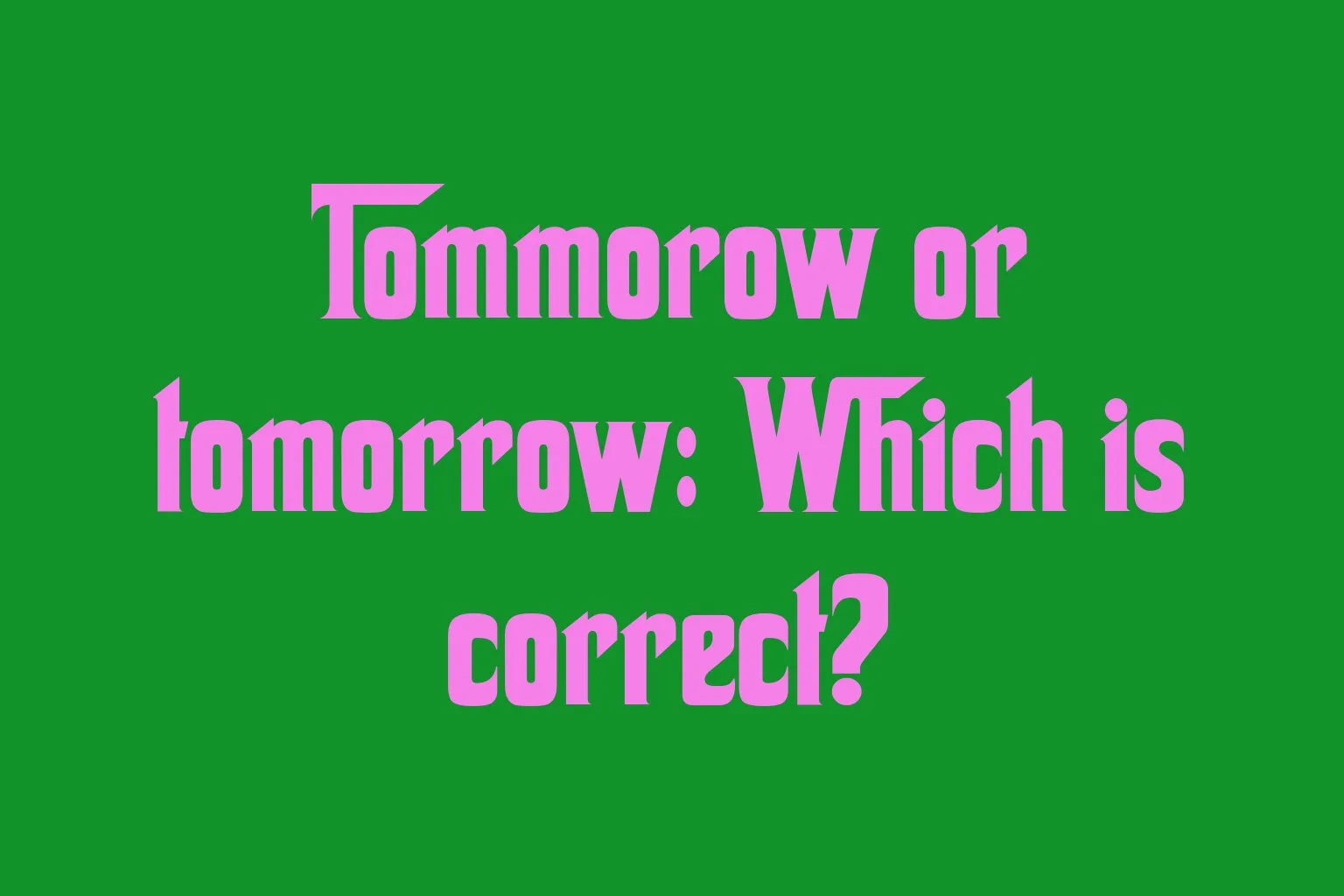
✅ Tomorrow
Correct. Uses one M and double R.
❌ Tommorow
Incorrect. A common misspelling.
Getting the spelling of tomorrow right can be tricky because of the way we pronounce it. The double letters often confuse writers, leading them to swap the “m” and the “r.” However, there is only one correct way to spell the word for the day after today. You should always use tomorrow. The version spelled as tommorow is a misspelling and should be avoided in all types of writing.
Why Is It Spelled Tomorrow?
To understand the spelling, it helps to look at the history of the word. Tomorrow essentially comes from the combination of the preposition “to” and the word “morrow,” which implies “morning.” Since “to” ends with a vowel and “morrow” starts with an “m,” we do not double the “m” when they combine.
Think of it as two distinct parts coming together:
- To (preposition)
- Morrow (meaning the following day or morning)
When you merge them, you get to-morrow. Notice that “morrow” already has the double “r” inside it. That is why the final word keeps the double “r” but strictly maintains a single “m”.
Easy Tricks To Remember The Spelling
If you find yourself hesitating over where to put the double letters, try these simple memory aids. They focus on breaking the word down into smaller, recognizable words.
1. Tom OR Row
You can break the word tomorrow into three separate, easy words: Tom, Or, and Row.
Imagine a person named Tom. You give him a choice: “Will Tom or Row the boat?” This little phrase contains all the letters in the correct order:
- Tom (Starts with T-O-M)
- Or (Adds the O-R)
- Row (Ends with R-O-W)
Put them together, and you have Tom-or-row.
2. Two Rs, One M
Another helpful tip is to focus on the count. Tomorrow has two Rs because it refers to a time that is running towards us. It only has one M because there is only one morning coming next.
| Word Form | Correct? | Notes |
|---|---|---|
| Tomorrow | ✅ Yes | Standard English spelling. |
| Tommorow | ❌ No | Incorrect double “m”. |
| Tommorrow | ❌ No | Incorrect double “m” and double “r”. |
| Tomorow | ❌ No | Missing the second “r”. |
Sentence Examples For Clarity
Seeing the word in action reinforces the visual pattern of the letters. Notice how the single “m” and double “r” look in these sentences.
- “I will submit the report by tomorrow afternoon.”
- “Are you free to meet tomorrow?”
- “The weather forecast for tomorrow looks sunny.”
If you wrote these with tommorow, spell checkers would immediately flag them as errors. While pronunciation might trick you into hearing a stress on the “m,” the written form stays consistent with its history.